By Randal Brandt
Randal Brandt is a librarian at the University of California, Berkeley where, among other things, he is curator of the Bancroft Library’s California Detective Fiction Collection. He is a past member of the MWA NorCal Board, 2018-2020.
Book: Scratch a Thief – John Trinian, 1961
Movie: Once a Thief – Zekial Marko (screenplay), Ralph Nelson (director), 1965
“Once a crook, always a crook. You, Pesak, you’re one of the biggest crooks I know. I can smell it on you. Like a guy can smell grass or smoke. And you’re a gunnie. I ought to know, punk. I ought to know.”
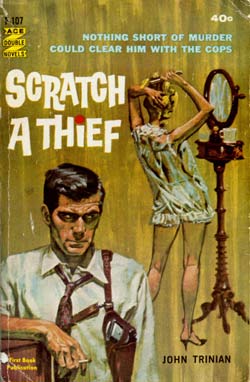 In John Trinian’s San Francisco, there are a lot of Hungarians. The grocers are Hungarian, the bartenders are Hungarian, the cops are Hungarian, and, most importantly, the crooks are Hungarian. Trinian’s novel Scratch a Thief was originally published as one half of an Ace Double-Novel paperback original in 1961 (with My Pal, The Killer by Chester Warwick) and tells the story of Eddie Pesak (full name: Bela Edward Pesak), a Hungarian ex-con who decided to go straight during a prison sentence for armed robbery.
When the story starts, Eddie has been paroled for five years and lives in a modest Excelsior district home with his beautiful Hungarian wife, Zara, and young daughter, Kathy. He is employed as a truck driver for Steffman’s Industrial Metals on Bayshore Avenue, near South San Francisco. His brother-in-law Cody (real name György) owns The Budapest Bar and Grill at Geneva and Mission, where Eddie can always get a free beer and a sympathetic ear.
However, Eddie has two big problems. The first is a police lieutenant named Mike Drago (né Mihaly Dragoman—you guessed it, Hungarian). Nine years ago, Drago was a patrolman who responded to a robbery in progress at a jewelry store. The gang committing the break-in was wearing gasmasks (in part to conceal their identities, but mainly because they knew the vault was equipped with tear-gas canisters that would erupt when they breached it) and Eddie was acting as the armed lookout. When he encountered Drago, he stumbled, his mask momentarily slipped down, and the gun accidentally went off, the bullet striking the cop in the stomach. Drago fingered Eddie as the shooter, but the identification didn’t stick and Eddie was acquitted.
Embarrassed that he was unable to bring his own assailant to justice, Drago now has a vendetta against Eddie, arresting him three previous times on spurious charges—resulting in Eddie losing three jobs. Ex-cons don’t get cut a lot of breaks from their employers.
Eddie’s second problem is his older brother, Walter. Eddie was orphaned as a very young child, and Walter assumed responsibility for raising his little brother. Walter, however, is a career criminal and is directly responsible for Eddie turning to a life of crime in the first place. Walter was the leader of the jewelry store heist crew (but he had nothing to do with the robbery that sent Eddie to prison—Eddie did that one all on his own).
Now, Walter is back in town with his crew, which includes the psychopathic Jimmy Sargatanas, and wants Eddie to join him on a new score, guaranteeing that his share of the take will be $100,000. Eddie turns him down flat.
The next day, Mike Drago is waiting for Eddie as he leaves work, arresting him while his co-workers look on. Once at the Hall of Justice, Eddie learns that he’s being held on a first-degree murder charge. The previous evening, two men held up a store and killed one of the proprietors. The murder was witnessed by the victim’s brother. The killer was the same height and weight as Eddie, wore a similar leather jacket trimmed with sheepskin, was called “Eddie” by his partner, and left the scene in a green 1930 Ford Model A—just like the distinctive car that Eddie drives. It seems like an open-and-shut case until the witness says that Eddie is not the guy who shot down his brother. Similar, sure, but definitely not the same person.
Even though the case falls through, Drago still holds Eddie in jail for the maximum three days without charging him. When Eddie gets out, he’s lost his job—again. He also is unable to draw unemployment since his employer says he quit (he didn’t show up at work for three days, after all), rather than being laid off or fired. His union rep says that jobs are scarce and then he is refused a bank loan. Eddie starts drinking more and becomes increasingly distant from Zara. Did I mention that this story takes place in December, in the days leading up to Christmas? Increasingly desperate for money, Eddie goes to see his brother.
Convinced that Walter set him up in the robbery/murder but realizing that the only way out of his circumstances is crime (“once a crook, always a crook”), Eddie asks Walter if the job offer is still good. That’s when Walter tells him they are going to hit Steffman’s for over half a million dollars’ worth of platinum. Eddie devises a plan to spoof the night security team and it works to perfection. When he realizes that Walter does not fully trust the rest of the gang, he figures out that it was Sargatanas, without Walter’s knowledge, who set him up.
Eddie takes the truck filled with platinum, hides it, and then everything goes pear-shaped. Walter is the only one who knows the name of the fence who is going to take possession of the loot and pay off the gang. Eddie finds Walter tortured and murdered by Sargatanas. Then he finds out that Sargatanas has kidnapped his daughter—Sargatanas will exchange Kathy for the truck. Knowing that he cannot get his daughter back on his own, Eddie goes to Drago to ask him for help. Drago agrees, on one condition, that Eddie confesses—in private—that he was the one who shot Drago during the jewelry heist. Eddie finally tells him the truth.
Eddie convinces Sargatanas to let Kathy go and in the ensuing shootout both he and Drago are wounded. But Eddie shoots Sargatanas and Drago convinces the brass that Eddie was working undercover with him to foil the robbery. Eddie is reunited with his family and they all live happily (and presumably honestly) ever after.
The story’s author, John Trinian, was born in 1933 in Salinas, California as Marvin Leroy Schmoker. He adopted the Trinian pseudonym for his fiction, but his preferred name was Zekial Marko, which he used as a scriptwriter for various TV shows, including Kolchak: The Night Stalker, Mission: Impossible, and The Rockford Files. He also used the name to adapt his own novel for the screenplay of Once a Thief.
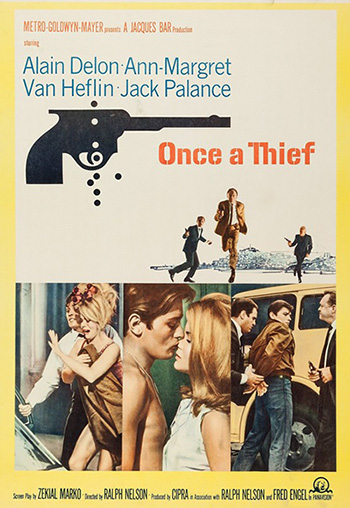 Given that Marko adapted his own work, it’s no surprise that the plot of the film follows the novel pretty closely. However, there are several significant changes.
After an extended, and mesmerizing, opening sequence in a smoky North Beach jazz club (nowhere in the film is the black-and-white photography more effective than in this scene), the plot kicks into gear when two men in a Model A Ford pull up to a grocery store in Chinatown and stick it up. The crooks’ faces are never shown, but the one holding the gun is wearing a sheepskin jacket. After he gets the money from the till, the gunman shoots the clerk, in full view of her husband. His partner calls out “Come on, Eddie, let’s go” and they split.
In the next scene, Eddie Pedak (Alain Delon), wearing a sheepskin jacket, pulls his Model A Ford up to an apartment building, where he picks up his beautiful wife Kristine (Ann-Margret) and young daughter, Kathy, and takes them to Fisherman’s Wharf to see the fishing boat on which he’s just put a $500 down payment.
In the film, Eddie is Italian, originally from Trieste. This leads the viewer to ask a natural question: Italian? It’s Alain Delon. Why is he not French? He could be from Marseille. Or even Algiers. No, he’s just an Italian with a French accent. Although never stated, Ann-Margret’s Kristine, whose role is greatly expanded from Zara’s in the novel, is American through and through. Eddie is an ex-con, out of prison for about six years after serving a 16-month sentence in San Quentin, determined to live an honest life from now on.
Eddie’s brother Walter (Jack Palance—sorry, there is no way that Alain Delon and Jack Palance could possibly be related) shows up at his apartment, with his creepy sidekick Sargatanas (John Davis Chandler), all white hair and dark sunglasses, in tow. Walter tells Eddie he needs him for a job and is willing to give him $50,000 up front. Eddie tells him to get out of his apartment (which makes Kristine, who is listening in the hallway, smile and breathe a sigh of relief).
When San Francisco police detective Mike Vido (Van Helfin), who also happens to be from Trieste, investigates the Chinatown killing, and hears the description of the killer from the eyewitness, he’s convinced he knows who it is (like in the novel, Vido had been shot in the gut while trying to stop a jewelry store heist). The next day he arrests Eddie at his truck-driving job, in front of his boss and co-workers, and takes him downtown. In jail, Eddie shares a cell with Luke Marko (Zekial Marko, in a part he wrote for himself), a dope-dealing ex-con he had first met in San Quentin. When the witness refuses to identify Eddie in the lineup, Vido watches his case fall apart just like it did in the novel.
Also like in the novel, when Eddie is finally released from police custody, he finds that he has lost his job, then can neither draw unemployment nor get a loan, and becomes increasingly frustrated and angry. Unable to find work, Eddie finally relents and lets Kristine get a job, thinking that she is waiting tables in a restaurant.
While Kristine is at work one evening, Walter, Sargatanas, and Shoenstein (another member of Walter’s crew) show up at Eddie’s apartment. They tell him that they are planning to rob Eddie’s former employer for a million dollars’ worth of platinum and they need Eddie’s help; his cut will be $50,000 (it was $100K in the book!). When Walter tells Eddie that his wife is “hustling” in a “joint,” Eddie rushes out and finds Kristine working in a nightclub as a cocktail waitress. In a rage, Eddie slaps her several times and nearly rips her skimpy dress off while dragging her out of the club. When they get home, Eddie tells Walter he’s in.
In the meantime, Vido continues to investigate the murder, trying desperately to uncover evidence of Eddie’s guilt. The opposite happens, however, when he finds out that a stolen Model A Ford, complete with a sheepskin jacket on the front seat, has been in the police impound lot for three days. Vido goes to see Eddie and tries to tell him that Walter framed him for the murder. Eddie throws Vido out and argues with Kristine, telling her he will call her late that night, and to pack and meet him at the boat.
When Eddie confronts Walter about the frame job, they realize that Sargatanas and Shoenstein did the murder, without Walter’s knowledge, in order to coerce Eddie into helping with the heist—with his inside knowledge, only he could plan it effectively. But, at this point, it is too late for Eddie to pull out and he goes along with the plan, which is executed to perfection… or nearly, that is.
After the heist, Sargatanas shoots Ling (Yuki Shimoda), a Chinese funeral home director whom Walter recruited as the safecracker (and, improbably, is also fluent in Italian). “One less split,” Sargatanas says. Realizing that Sargatanas has plans of his own, Walter and Eddie take off with the van full of the stolen platinum, ditch Sargatanas and Shoenstein, and split up, with Eddie taking the platinum.
When Eddie meets Kristine at the boat, she is hysterical, telling him that “they took Kathy.” Eddie goes to Walter and finds him shot and dying, with a note from Sargatanas pinned to his chest, telling him to wait. Sargatanas calls Eddie and lets him speak to Kathy. The rest is simple: when Eddie gives Saragatanas the platinum he gets his daughter back.
Realizing that there is only one person left that Eddie can trust, he drives to Vido’s house in Bernal Heights and Vido’s mother lets him in (where, naturally, they speak Italian to each other). When Vido enters, he finds Eddie in his living room, sitting with a gun under a coat on his lap. Eddie tells Vido that he has the platinum and that Sargatanas kidnapped his daughter. He asks for Vido’s help in getting his kid back. Just him though, no police. Vido agrees on one condition—that Eddie confess to shooting Vido during the jewelry store robbery, which he does.
Meanwhile, Kristine has been waiting on the dock for Eddie to call. Increasingly desperate, she finally calls the police, trying to find Vido. However, she gets his partner, Kane, and tells him what is going on and where she is.
What follows next makes the film exponentially darker than the novel.
The police arrive at the waterfront. Eddie meets with Sargatanas, bringing the truck full of platinum, and convinces him to let Kathy go; Eddie tells Kathy to go find her mother at the boat, and off she skips. Then all hell breaks loose. Sargatanas shoots Shoenstein, Vido catches a bullet in the shoulder, Eddie shoots Sargatanas (four times!), and then Kane, ignoring Drago’s pleas, shoots Eddie. Kathy, meanwhile, has found Kristine and they race back toward the scene of the shootout. Kathy runs to the fallen Eddie and, thinking he is playing a game, climbs on top of him and closes his eyes. The end.
Pure noir.
Despite the star power of Alain Delon and Ann-Margret (Delon was making his Hollywood debut and Ann-Margret had just co-starred with Elvis Presley in Viva Las Vegas) the film was a box office flop. Some critics thought Delon was miscast, but I would argue that it is the character of Walter that would have benefitted from a different actor. Jack Palance’s acting is fine; he is just not believable as Eddie’s brother.
In her introduction to the 2016 Stark House Press reissue of Scratch a Thief, Ki Longfellow (née Pamela Kelly) provides some insight into the filmmaking process. Longfellow was a long-time close friend of Zekial Marko and he wrote a small cameo for her in the film. Since she and Marko were both actors in the film, they got to hang around the set and she dished about what went on behind the scenes.
“Filming Once a Thief was tedious. Except the intrigue that wasn’t filmed. Alain Delon, a French hotsie, hated Ann-Margret. In a scene filmed in the club where Carol Doda was nightly baring her impressive boobs, Alain got to slap Ann-Margret around. He relished it. By the time they got it right, her face was as red as her shame. She was not having a good time.”
In a twist of irony, the part that Marko wrote for himself, Luke, was supposed to be a pot-smoker who shares a jail cell with Eddie. The night before shooting that scene, Marko was himself arrested on a cannabis charge and thrown into jail. Luckily, they were shooting on location in the L.A. County Jail, so Marko was transferred to the cell they had lit for the scene, played his part, and was returned back to his real cell.
Marko had made a name for himself among the Beats in San Francisco’s North Beach. He was at the famous Six Gallery reading of Allen Ginsberg’s Howl in 1955 and was close to Richard Brautigan, Lew Welch, Philip Whalen, and other Beat luminaries. Although Once a Thief was filmed in 1965, several years after the twin heydays of film noir and San Francisco Beat culture, it contains strong elements of both—let’s call it Beat Noir.